Interaction-as-a-Judge
1 Carnegie Mellon University 2 Arena 3 University of California, Berkeley 4 University of California, Los Angeles
* Work done as part of an internship at Arena.
Abstract
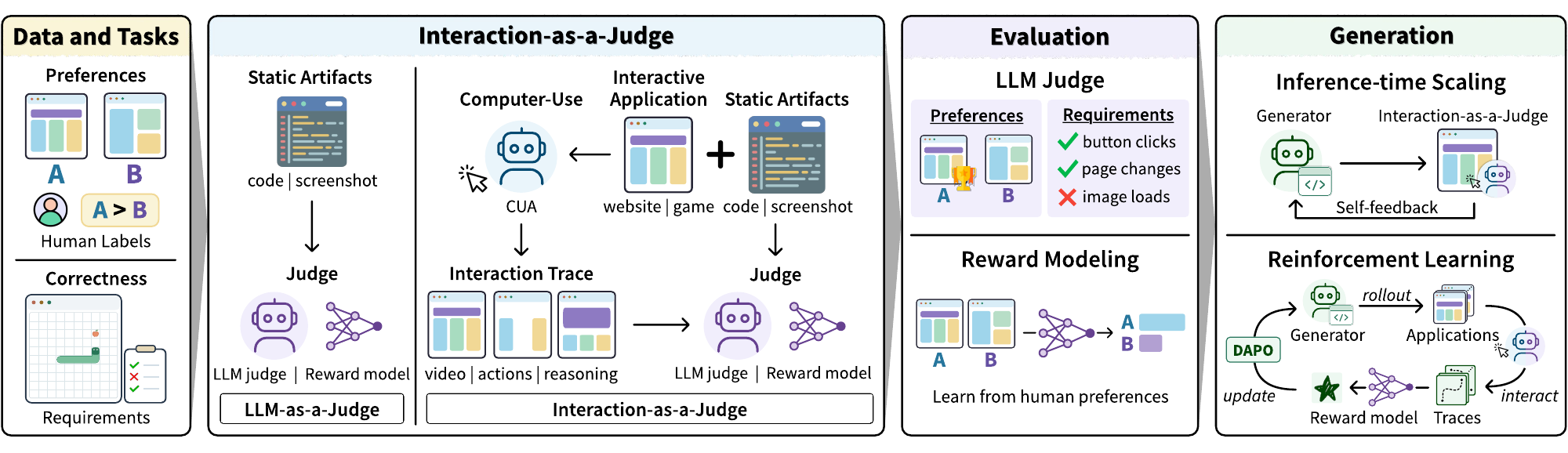
Coding agents are tasked with producing sophisticated interactive applications such as websites, desktop applications, and games. While humans assess these applications interactively, current automated LLM evaluations primarily focus on code analysis and unit tests. This mismatch can cause LLM judges to miss failures that are immediately apparent to human users. We study Interaction-as-a-Judge, an evaluation paradigm where computer-use agents (CUAs) directly interact with an application. We demonstrate that Interaction-as-a-Judge can improve both evaluation and generation of interactive applications. To this end, we collect and release two complementary datasets: 6,858 pairs of applications with human preferences and corresponding agent traces, and 222 applications with human-verified requirement labels. Relative to standard non-interactive approaches, we find that Interaction-as-a-Judge improves evaluation in terms of predicting human preferences (65.6% → 69.1%) and requirement verification (77.0% → 81.6%). We also observe scaling benefits: across both preference alignment and requirement verification, higher-quality interactions improve performance. Finally, through both inference- and training-time experiments, we demonstrate that Interaction-as-a-Judge can also improve the quality of generated artifacts. At inference time, Interaction-as-a-Judge repairs 75.5% of broken requirements within five attempts, compared to 55.4% for code-only self-feedback. At training time, using Interaction-as-a-Judge as a reward signal improves win-rate over the base model by 6.7pp while reducing both generated code length by 35.7% and build failure rates by 7.2pp compared to a code-only reward signal.
Human preferences
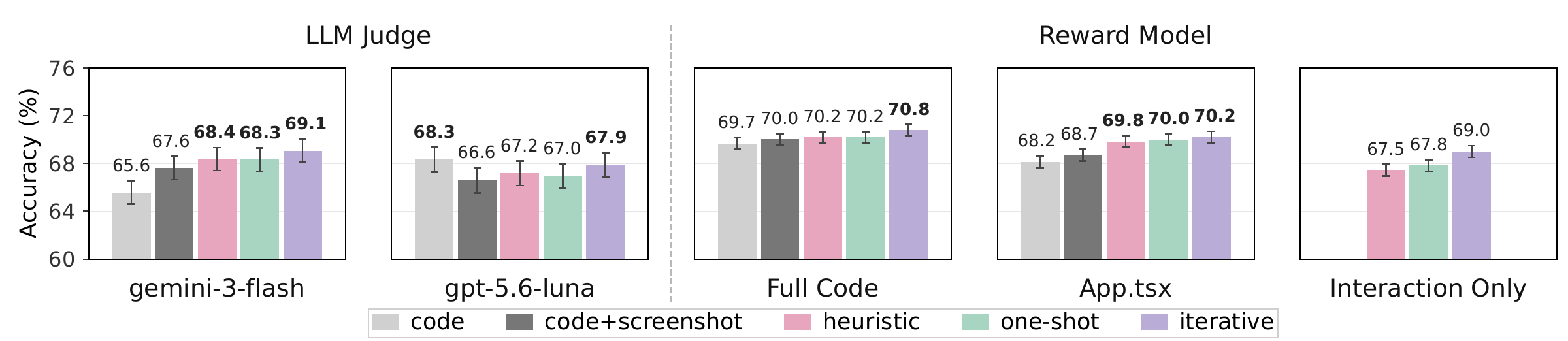
With iterative computer use, Gemini 3 Flash’s agreement with human preferences improves from 65.6% to 69.1%. A trained reward model reaches 70.8%, outperforming the off-the-shelf LLM judges. Interaction traces alone also support reward-model training without access to code.
Correctness verification
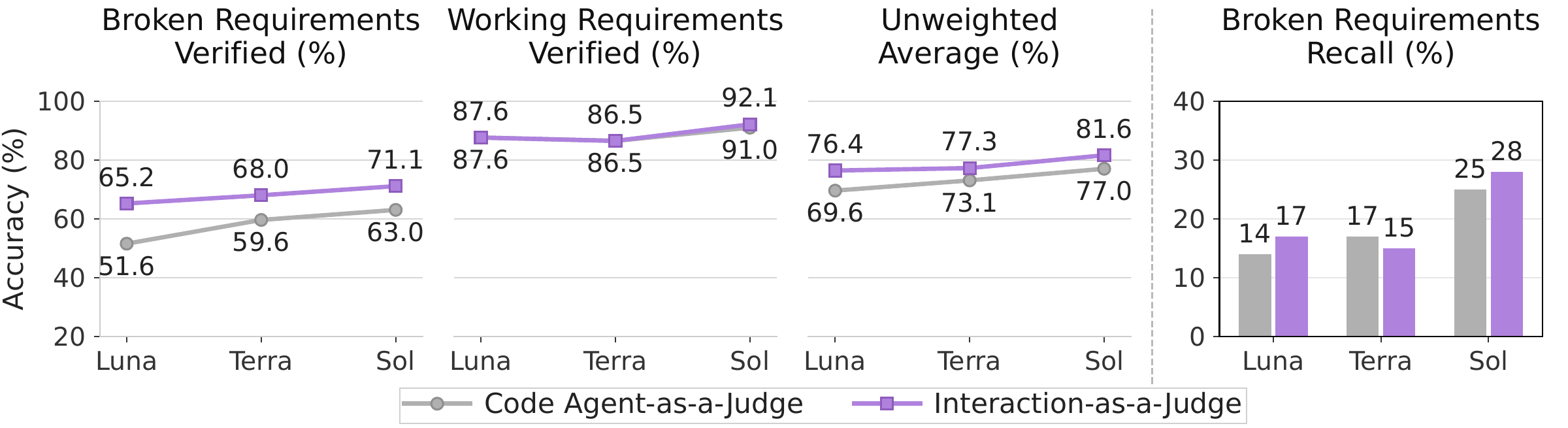
With GPT 5.6 Sol, interaction improves balanced requirement-verification accuracy from 77.0% to 81.6%. The largest gain comes from identifying broken requirements: 63.0% to 71.1%. Verification improves as the computer-use model becomes more capable.
Inference-time scaling
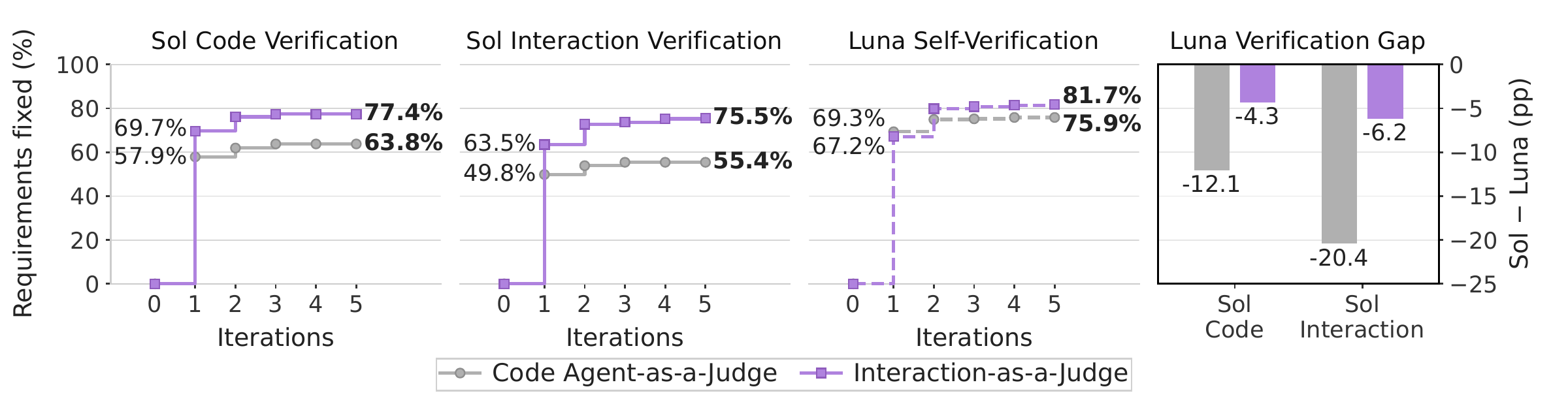
Interaction-based self-feedback repairs 75.5% of initially broken requirements within five attempts, compared with 55.4% for code-only self-feedback. The improvement persists under both interaction-based and code-only evaluation, with a smaller gap between self-reported and externally evaluated success.
Training
Reinforcement learning with an interaction-only reward model improves Qwen-3.5-9B’s win rate over the base model by 6.7 percentage points, equivalent to over +50 points on Arena’s leaderboard according to our internal calibrations. Compared with a code-only reward signal, it generates 35.7% less code and increases build success from 81.3% to 88.5%.

Datasets
ArenaPreferences. 6,858 application pairs across seven categories, with real user prompts, agentic traces, and human preference labels.
ArenaCorrectness. 222 application versions with 412 human-verified requirements, drawn from 67 game development traces.
Coming soon. Both datasets have not yet been publicly released. Download links will be added here when they are available.
Citation
Download BibTeX@misc{chi2026interactionasajudge,
title = {Interaction-as-a-Judge},
author = {Wayne Chi and I-Hung Hsu and Li Chen
and Wei-Lin Chiang and Ion Stoica
and Anastasios Nikolas Angelopoulos
and Ameet Talwalkar and Chris Donahue
and Cho-Jui Hsieh},
year = {2026},
url = {https://interaction-judge.github.io}
}